
Requirements and Documents Checklist
What to prepare before filing on IMUGA: passport validity, flight and accommodation details, visa on arrival conditions, and rules for residents and crew.
Filling in the Maldives Traveller Declaration takes about ten minutes — if you have everything in front of you. Most delays come from hunting for a passport number, a resort name or a flight code halfway through the form. This guide lists exactly what the IMUGA portal asks for, and what Maldives Immigration will separately expect at the border.
In 30 seconds: For the declaration itself you need your passport details, nationality and date of birth, your flight numbers, confirmed accommodation, an email address and a contact number. For the 30-day visa on arrival you also need a passport valid for at least six months, a return or onward ticket, sufficient funds and a confirmed booking. The declaration has no cost on IMUGA; assistance services are optional.
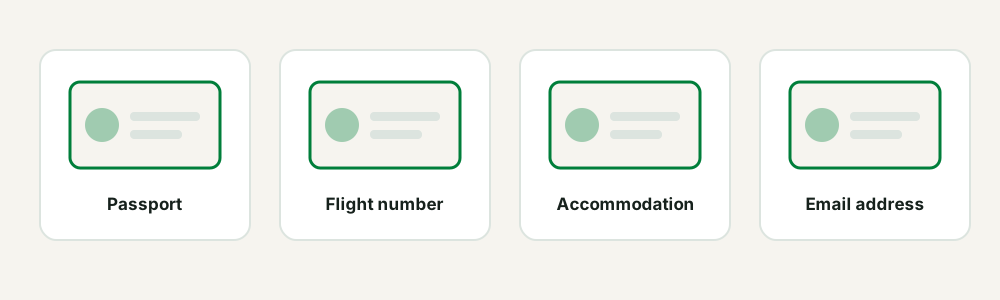
Two different checklists, one trip
It helps to separate two things that travellers routinely merge.
The Traveller Declaration is an online form. It collects data. Nobody inspects your bank statement while you fill it in, and you do not upload your hotel voucher. What matters is that the information you type is accurate and matches your documents.
The visa on arrival is a decision made by an immigration officer at Velana International Airport (MLE) or another entry point. There, physical evidence can be requested: the ticket home, the booking confirmation, proof that you can pay for your stay.
Both are mandatory in practice. You cannot board without the declaration's QR code, and you cannot enter without meeting the visa conditions.
Quick summary: The declaration is a data form; the visa on arrival is an assessment at the border. Prepare for both.
The core data checklist
Use this table as your pre-flight gathering list. Every row is something you will either type into IMUGA or may be asked to show on arrival.
| Item | Needed for | Where to find it | Common mistake |
|---|---|---|---|
| Passport number | Declaration + border | Photo page, top right | Confusing 0 with O, or using an expired passport |
| Passport validity (6+ months) | Border | Photo page expiry date | Counting validity from booking date, not arrival date |
| Full name as printed | Declaration + border | Photo page | Omitting a middle name or second surname |
| Nationality | Declaration | Photo page | Entering country of residence instead |
| Date of birth | Declaration | Photo page | Swapping day and month formats |
| Arrival flight number and date | Arrival declaration | Airline booking or e-ticket | Using the first leg instead of the Maldives leg |
| Departure flight number and date | Departure declaration | Airline booking | Forgetting the form exists |
| Accommodation name and island | Declaration + border | Hotel or resort voucher | Typing a nickname instead of the registered name |
| Email address | Declaration (QR delivery) | — | Typos; the QR goes nowhere |
| Contact phone number | Declaration | — | Missing international dialling code |
| Return or onward ticket | Border | Airline booking | Only having a one-way ticket |
| Sufficient funds | Border | Card, cash, prepaid resort | Assuming an all-inclusive booking removes the need |
| Health information | Declaration | Self-declared | Rushing without reading the question |
Quick summary: Passport, flight, accommodation and contact details cover the form; the ticket home and funds cover the border.
Passport requirements in detail
Your passport is the single point of failure in this process. Three rules matter.
- Six months of validity from the date of arrival. Not from the date you booked, and not from the date you file the declaration. If your passport expires in October, an arrival in early June is fine; late May with a June arrival is not.
- Machine-readable and undamaged. Water damage, a detached page or a heavily worn photo page can create problems at check-in even before you reach immigration.
- The passport you declare is the passport you travel with. Dual nationals must pick one and use it consistently across the booking, the declaration and the border.
If you renew your passport between filing and flying, submit a new declaration with the new number. A QR code tied to a superseded document is not a document you want to present at check-in.
Expert tip: Photograph your passport photo page and save it offline before you start. Reading the number from a screenshot is far more reliable than reading it from a passport under airport lighting.
Quick summary: Six months validity from arrival, undamaged, and identical across booking, declaration and travel.
Flight and itinerary details
The declaration asks for the flight that crosses the Maldivian border, not your whole journey.
- Enter the arrival flight number exactly as shown on your ticket, including the airline code (for example EK, QR, TK or BA followed by the number).
- Enter the arrival date in Maldives local time. Overnight flights often land the day after departure — that later date is the one that counts.
- Do the same, separately, for your departure flight.
- Codeshare bookings can show two flight numbers. Use the operating carrier's number, which is the one on your boarding pass.
- Layovers in Doha, Dubai, Istanbul or Colombo are not entered anywhere.
Because arrival and departure are two distinct forms with two distinct submission windows, plan for both. Our guide on the 96-hour window explains when each one opens.
Quick summary: Use the operating carrier's flight number and the local arrival date, and remember there are two forms.
Accommodation: what counts as confirmed
"Confirmed accommodation" means a booking that exists in a property's system and can be verified, not a placeholder.
Acceptable options include:
- A resort booking, the most common case, usually with an included transfer.
- A hotel in Malé or Hulhumalé, often used for arrival or departure nights.
- A guesthouse on a local island.
- A safari boat or liveaboard, where the vessel is your accommodation.
- A private residence, if you are staying with a host who can be named.
Enter the property exactly as it appears on the voucher, including the island name. If your trip includes several properties, declare the first one and keep the remaining vouchers accessible.
Quick summary: Declare a real, confirmed booking, named exactly as on the voucher, starting with your first night.
The 30-day visa on arrival
The Maldives grants most nationalities a no-cost 30-day visa on arrival. There is no application form and no fee, but there are conditions, and they are checked.
- A passport valid for at least six months on arrival.
- A confirmed accommodation booking for your stay.
- A return or onward ticket out of the Maldives.
- Sufficient funds to cover your stay, or evidence that costs are prepaid.
The declaration does not replace this. Filing the form does not guarantee entry, and holding a QR code is not a visa. Conversely, meeting the visa conditions does not exempt you from the declaration — you will be asked for the QR at airline check-in.
Quick summary: The visa on arrival has no cost and is automatic for most travellers, but only if the four conditions are satisfied.
Proof of funds: what officers actually look for
This is the vaguest requirement and the one that causes the most anxiety. In practice, officers want reassurance that you are not arriving without means.
- A prepaid resort booking covering your whole stay is the strongest evidence, since accommodation is the dominant cost.
- An international credit or debit card in your name is normally sufficient alongside a booking.
- Some travellers carry a recent bank statement as backup; it is rarely requested but costs nothing to have on your phone.
- Cash is accepted but not required. There is no published fixed amount.
Independent travellers staying in guesthouses on local islands are asked slightly more often than resort guests, simply because less is prepaid.
Quick summary: A confirmed booking plus a working card covers almost every case; no fixed sum is published.
Special cases
Not every traveller fits the tourist template. The declaration itself is still mandatory for everyone, including Maldivian citizens, but the surrounding requirements vary.
- Residents and work permit holders. You still file both declarations for every trip. Carry your residence or work permit card, since your entry is processed under that status rather than as a tourist visa.
- Business travellers. A short business trip is usually handled under the standard visa on arrival, but the purpose of travel should be declared honestly. Longer or paid work requires the correct permit arranged in advance.
- Airline and vessel crew. Crew members travelling on duty are processed under crew procedures; when travelling as passengers, the ordinary rules apply.
- Safari boat and liveaboard guests. Declare the vessel as accommodation and keep the charter confirmation to hand. Your arrival airport is still MLE, GAN, NMF or HAQ.
- Transit passengers. If you clear immigration, you need the declaration. Airside transits without entering the country are treated differently, but if you are unsure, filing is the safe option.
- Children and infants. Every minor needs their own declaration and their own passport, though a parent can submit for the whole family from one account. See our guide on families and children.
Quick summary: Everyone declares; the difference lies in which status your entry is processed under.
What the form asks versus what immigration asks
The two checklists overlap but are not identical, and knowing the difference saves worry.
- The form asks for typed data only: identity, passport, flight, accommodation, contact, health. Nothing is uploaded.
- Immigration may ask to see evidence: the physical passport, the return ticket, the booking, and occasionally proof of funds.
- The airline asks for one thing at check-in: your QR code, alongside the passport.
- Nobody at any stage charges you for the declaration itself. It has no cost on the official IMUGA portal, as explained in our guide on what the declaration costs.
If a detail on your form does not match the document you present, expect questions. Accuracy matters far more than speed.
Quick summary: The form takes data, the border takes evidence, and the airline takes the QR code.
Final preparation routine
A simple sequence keeps everything calm:
- Two weeks out: check passport validity and confirm accommodation.
- One week out: save your passport photo page, flight confirmations and vouchers into one phone folder.
- Three days out: file the arrival declaration as soon as the window opens.
- On receipt: save the QR code offline and, if you can, print it.
- Three days before flying home: file the departure declaration from your resort.
For the mechanics of the form itself, follow our step-by-step IMUGA walkthrough.
Quick summary: Gather early, file inside the window, save the QR offline, then repeat for the return.
Key Takeaways
- The declaration needs passport, nationality, date of birth, flight, accommodation, email and phone.
- The 30-day visa on arrival additionally needs six months of passport validity, a return ticket, a booking and funds.
- Nothing is uploaded to the form; evidence is shown at the border, not online.
- Safari boats count as accommodation, and residents, workers and crew still file declarations.
- A new passport or a changed booking after filing means submitting a fresh declaration.
- The form is no-cost on IMUGA; assistance services are optional and paid.
Frequently Asked Questions about requirements
How much passport validity do I need for the Maldives?
At least six months from your date of arrival. Airlines often check this at check-in, so a passport close to expiry can stop your trip before it starts.
Do I have to upload documents to the declaration?
No. The IMUGA form collects typed information only. Your passport, ticket and booking are shown to immigration officers on arrival if requested.
Is a return ticket really required?
Yes, a return or onward ticket is one of the conditions for the 30-day visa on arrival. One-way travellers can be refused boarding or entry.
How much money should I have for the trip?
There is no published fixed amount. A prepaid resort booking plus a valid international card is normally considered sufficient evidence.
Can I declare a booking that is not yet confirmed?
You should not. Declare confirmed accommodation only, since a later change usually means submitting a new declaration with correct details.
What do I enter if I stay on several islands?
Enter your first confirmed accommodation on arrival and keep the other vouchers available in case an officer asks about your itinerary.
Do residents and work permit holders need the declaration?
Yes. Every traveller files it, including Maldivian citizens, residents and work permit holders, for both arrival and departure.
What about safari boat or liveaboard guests?
Declare the vessel as your accommodation and keep the charter confirmation handy. Your arrival is still processed at the international airport.
Does the declaration act as a visa?
No. It is an immigration data form. The 30-day visa on arrival is granted separately by an officer once conditions are met.
What happens if my passport number changes after filing?
Submit a new declaration with the new passport details. The QR code must match the document you present at check-in and immigration.
Last updated: July 2026. Immigration rules can change; always check the current requirements on the official Maldives Immigration portal before you travel.