
Maldives Declaration for Families and Children
A practical family guide to the Maldives Traveller Declaration: one form per traveller including newborns, group submissions from a single account, and who signs for a minor.
Travelling to the Maldives with kids adds one paperwork rule that surprises almost every parent: the Maldives Traveller Declaration is filed per person, not per family. A newborn on your lap, a nine-year-old with their own seat and a grandparent joining the trip each need a separate IMUGA submission and each receives a separate QR code. The good news is that one adult can complete all of them in a single sitting, from one account and one email inbox.
In 30 seconds: Every traveller entering or leaving the Maldives needs their own Traveller Declaration, including infants who do not occupy a seat. A parent or guardian can submit the whole family as a group from one IMUGA account inside the 96-hour window before travel. Each person needs their own passport number, and each submission returns its own QR code. You will repeat the process for departure.
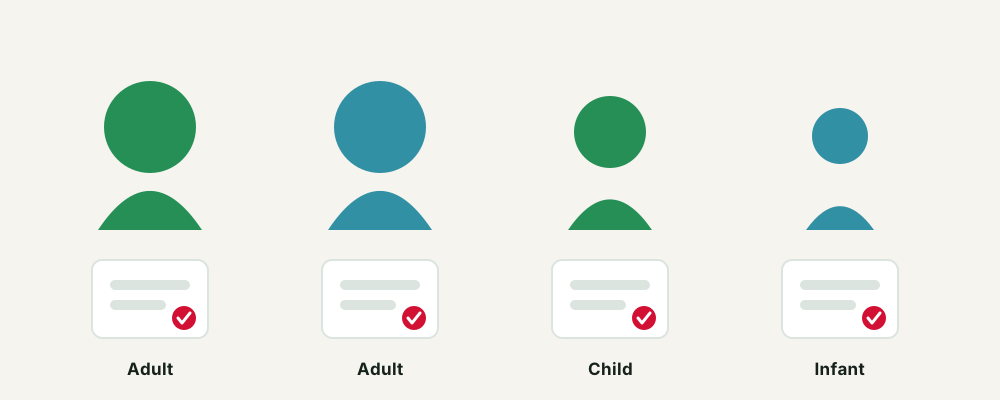
One form per traveller: no exceptions for babies
The rule that trips families up is simple once you accept it. The Maldives Immigration Traveller Declaration is tied to a passport number, not to a booking reference or a household. If a person has a passport and is boarding the plane, that person needs a declaration. That includes:
- Infants under two travelling as lap children with no seat of their own.
- Children added to a parent's passport in older document formats — they still need their own submission using the passport details they travel on.
- Teenagers who already hold adult-format passports.
- Grandparents, nannies, au pairs and any adult joining the family trip.
- Maldivian citizens and residents returning home with the family.
There is no family option, no "add dependants to this form" checkbox and no exemption based on age. Airlines check the QR code against the passenger manifest at check-in, so a missing child declaration is caught before you reach the gate — not at immigration.
A common misconception is that a lap infant "does not count" because they have no ticket of their own in the usual sense. Infants do appear on the manifest, they do cross the immigration desk, and their passport is stamped. Immigration systems treat them as arriving travellers exactly like everybody else.
Quick summary: If they have a passport and are on the flight, they need their own declaration — age is irrelevant.
How to submit the whole family from one account
You do not need six email addresses for six travellers. IMUGA lets one person act as the submitter for a group, which is how most families handle it. The practical flow looks like this:
- Collect every passport in front of you before you start. Physical documents or clear photos of the data page — do not work from memory.
- Open the IMUGA portal inside the 96-hour window and choose the arrival declaration.
- Complete the first traveller — usually the adult who will be the family contact — using their own passport and the shared contact email.
- Submit it, wait for the confirmation email, then start the next traveller. Some sessions offer an "add another traveller" flow that carries the flight and accommodation data forward; use it when available, because it removes most of the retyping.
- Repeat until every person has a confirmed submission and a QR code in the inbox.
- Save all QR codes into one folder or one PDF before you close the laptop.
The shared contact email is the piece worth thinking about. Use an inbox that the travelling adults can actually open on the phone at the airport, not a work address behind a corporate VPN. If both parents can access the mailbox, both can pull up any child's QR code at the counter.
Expert tip: Do the family batch on a laptop, not on a phone. Typing eight passport numbers on a touchscreen is where transposed digits come from, and a wrong passport number is the single most common reason a family declaration has to be redone at the airport.
Quick summary: One adult, one account, one email inbox — but one separate submission and QR code per person.
Traveller type reference table
| Traveller type | Own declaration? | Notes |
|---|---|---|
| Infant under 2 (lap child, no seat) | Yes | Uses the baby's own passport number; a parent completes and signs the form |
| Child 2–11 with own seat | Yes | Same fields as an adult; health section answered by the parent |
| Teenager 12–17 | Yes | Can complete it themselves, but a guardian remains responsible for accuracy |
| Adult 18+ | Yes | Files their own, or is added to a family group submission |
| Grandparent or relative travelling with you | Yes | Separate submission even if they share the accommodation booking |
| Nanny, carer or au pair | Yes | Independent traveller for immigration purposes |
| Child travelling with one parent only | Yes | Declaration is standard; carry supporting documents for the border check |
| Child travelling with grandparents, no parent | Yes | Declaration is standard; a parental authorisation letter is strongly recommended |
| Maldivian citizen or resident child | Yes | Citizens and residents are covered by the same obligation |
| Passenger in transit staying airside | No | Not entering the country; confirm with the airline for long layovers |
| Honeymoon couple | Yes, one each | Two arrival forms plus two departure forms for the trip |
| Group of 10+ friends or extended family | Yes, one each | Split the batch between two adults to avoid session timeouts |
Quick summary: The only traveller on this list who may skip the form is one who never clears immigration.
Passports: every child needs their own document
Before the declaration comes the document. Most countries now issue individual passports for minors, but a few families still travel on older combined documents or with a child endorsement. Check these points early, ideally weeks before departure:
- Validity. The Maldives expects a passport valid for at least six months on arrival. Children's passports have short validity — five years or less in many countries — so they expire far sooner than parents expect.
- Name spelling. The declaration must match the machine-readable zone exactly, including hyphens and second surnames.
- Renewals in progress. If a child's passport is being renewed, you cannot file the declaration with the old number and expect it to work. Wait for the new document.
- Emergency or temporary passports. These have their own number format; use exactly what is printed on the document.
If a child's passport arrives late and you are already inside the 96-hour window, file the declaration the moment the number is in your hands. The window is short, but it only takes minutes per traveller.
Quick summary: No individual passport, no valid declaration — sort the documents before you worry about the form.
Who signs and who is responsible for a minor's form
The declaration includes a truthfulness confirmation. For anyone under 18, the parent or legal guardian completing the submission is the person confirming that the information is accurate. In practice:
- The adult who submits the form is the accountable party for that child's data.
- A teenager may fill in their own details, but the guardian should read the whole form before submitting.
- Health questions are answered on the child's behalf. Answer them honestly; a mild cold is not a problem, and inventing a clean bill of health when a child has a notifiable illness is.
- Accommodation and flight details must match the child's actual itinerary, which is normally identical to the parent's.
If two households are involved — separated parents, for example — decide in advance who submits and make sure that person has the passport data and the flight confirmation. Two people filing duplicate declarations for the same child creates confusion at the desk.
Expert tip: Whoever submits the family batch should also be the person carrying the printed backup. Splitting the QR codes between two phones sounds redundant-proof, but at check-in it usually means one parent standing at the counter while the other queues for coffee with half the codes.
Quick summary: The submitting adult signs for the minor and owns the accuracy of every field.
Single-parent travel, grandparents and different surnames
The Traveller Declaration itself does not change when a child travels without both parents. There is no extra field, no special category and no separate form. What changes is what border officers may ask to see, in the Maldives or at your departure airport.
Recommended supporting documents, none of which are uploaded to IMUGA but all of which are worth carrying:
- A signed parental authorisation letter from the non-travelling parent, with contact details and passport copy.
- The child's birth certificate or family book, especially when surnames differ.
- A custody order or court document if one parent has sole custody.
- A death certificate where one parent is deceased.
- For grandparents or other relatives: a letter from both parents naming the accompanying adult and the travel dates.
Airlines at the departure airport are often stricter than Maldivian immigration on this point, particularly on long-haul routes with a connection. Have the paperwork in the hand luggage, not in the hold.
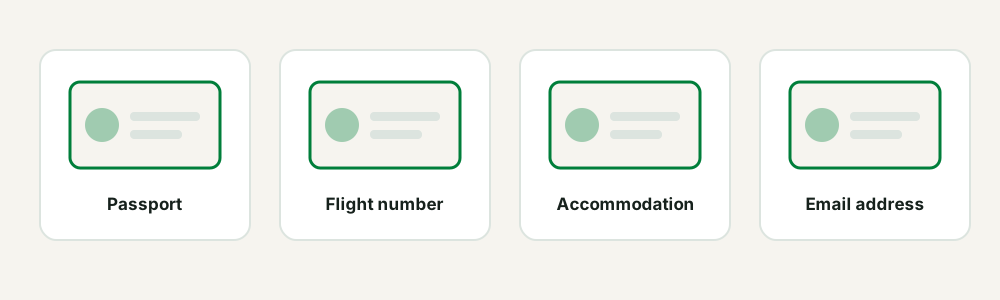
When surnames do not match
Blended families, families where the mother keeps her birth surname, and Spanish-speaking or Portuguese-speaking families with two surnames all hit the same friction: the names on the declarations do not obviously belong together. This is not a problem for IMUGA — each form is independent — but it can slow a check-in agent down.
Three things help:
- Enter names exactly as printed in the passport, including both surnames where they appear. Do not shorten, reorder or anglicise.
- Keep the family group on the same booking reference where possible, so the airline sees them as one party.
- Carry a birth certificate or family record linking parent and child if the surnames share nothing.
The declaration is matched to the passport, not to the family, so mismatched surnames never invalidate a submission on their own.
Quick summary: The form never changes for single-parent, grandparent or mixed-surname travel — the supporting paperwork is what smooths the checks.
Big groups, honeymoons and multi-generational trips
Two ends of the spectrum, one shared rule. A honeymoon couple needs four declarations for the trip: two arrivals and two departures. A twelve-person family reunion needs twenty-four. Nobody is exempt because they are part of a booking.
For large groups:
- Nominate two submitters and split the list between them. Sessions can time out, and two people working in parallel halve the exposure.
- Build a shared spreadsheet with name, passport number, expiry date, flight and accommodation before the window opens. Then the actual filing is copy-paste.
- Agree one accommodation entry so everybody's form matches — resorts often have a formal name that differs from the booking site listing. Use the name on the confirmation voucher.
- File everything on the same day so all confirmations land together and none is forgotten.
- Tick each person off the spreadsheet only when their QR code is in the inbox, not when the form is submitted.
Honeymooners have one specific risk worth naming: newly married travellers sometimes book flights in a married name while the passport still shows the birth name. Always file the declaration against the passport name. Change the flight booking, never the declaration.
Quick summary: Multiply the traveller count by two — arrival plus departure — and that is your form count for the trip.
Keeping several QR codes organised
Six QR codes in one inbox is where family trips go wrong. The codes look nearly identical, they arrive in separate emails, and at the check-in counter you have thirty seconds and a queue behind you. Get organised before you leave home.
A method that works:
- Download every QR code as a PDF and rename each file
01-Surname-Firstname-ARRIVAL.pdf. - Combine them into a single PDF in family order and store it offline on the phone that will be at the counter.
- Print one copy per adult and put them in different bags.
- Add the codes to a phone wallet app if yours supports it.
- Repeat the whole exercise for the departure declarations and keep the two sets clearly separated.
Never rely on searching your inbox at the airport. Airport wifi is slow, roaming may not have activated yet, and the confirmation email is easy to lose under booking spam.
For a deeper look at how the codes are issued and what happens if one never arrives, read our guide to the Maldives Traveller Declaration QR code.
Quick summary: One offline PDF, one printed set per adult, arrival and departure kept apart.
What the airline and immigration actually check
Knowing what happens at each checkpoint removes most of the anxiety. There are three moments where a family's declarations matter:
- Check-in at your departure airport. The agent matches each passenger on the booking to a valid declaration. This is where a missing child form is discovered, and it is the worst possible moment to find out.
- Immigration at Velana International Airport. Officers see the submitted record linked to each passport. Children walk through with the accompanying adult, but each record must exist.
- Departure check-in in Malé. The same process in reverse, with the departure declarations.
Families with young children usually get some flexibility on queue position at Velana, but no flexibility at all on documentation. A tired toddler does not make a missing form appear.
Expert tip: Photograph every passport data page and store the images in the same offline folder as the QR codes. If a form has to be redone at the airport, having the numbers on the phone rather than digging passports out of a bag while holding a pushchair saves ten stressful minutes.
Quick summary: Three checkpoints, three moments where a missing child declaration surfaces — the first one is the airline counter at home.
Timing: the 96-hour window with kids in the house
The declaration can only be submitted within 96 hours (four days) of travel. Filing earlier does not work — the form will not accept it — and filing later means doing it in a rush. With children in the mix, the practical advice is to pick a fixed slot and defend it.
- Set a calendar reminder for the morning the window opens.
- Do the batch when the kids are at school or asleep. Passport numbers and interruptions do not mix.
- Leave a buffer of at least 24 hours before departure so there is time to fix a rejected form.
- Remember the return trip. Set a second reminder for the departure declaration while you are still on holiday.
That last point catches more families than the arrival form does. You are relaxed, the resort wifi is patchy, and nobody is thinking about paperwork. A reminder set at home solves it.
Our dedicated guide explains the 96-hour submission window in full, including what happens across time zones and long connections.
Quick summary: Open the window, block an hour, file everybody, then set the reminder for the departure batch.
Common family mistakes and how to avoid them
Most family problems are clerical, not legal. The list below covers what actually goes wrong:
- Forgetting the baby entirely. The most frequent single error.
- Filing one form and listing the children inside it as accompanying passengers. There is no such field.
- Using a child's old passport number after a renewal.
- Filing the arrival declaration for everybody and the departure declaration only for the adults.
- Mixing up two children's dates of birth when copying data quickly.
- Using an email address nobody can open at the airport.
- Assuming a Maldivian resident child is exempt. Residents and citizens file too.
If you spot an error after submission, do not stack a second form on top blindly — check whether the portal allows a correction first, and keep both confirmations if you do end up with duplicates so you can show the correct one.
Our guide to common Traveller Declaration mistakes covers correction routes in detail, and the requirements guide lists every field you will be asked for. If you are still unclear on how the two submissions per trip work, the arrival and departure declaration guide explains the pairing.
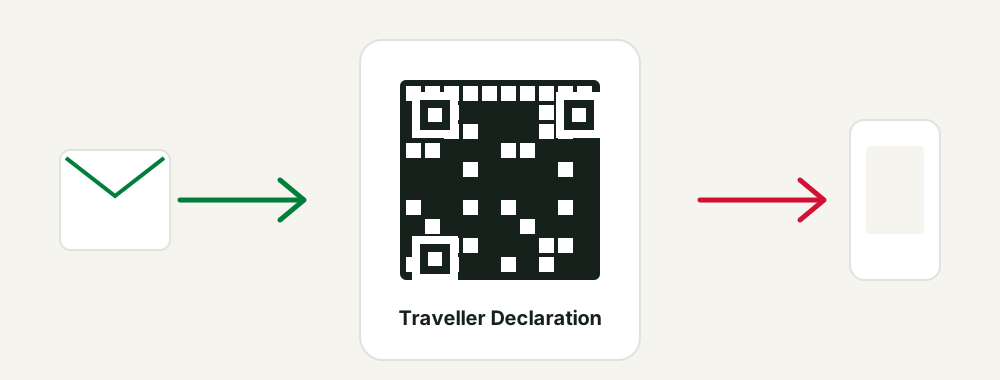
Quick summary: Count the travellers, count the forms, and make sure the two numbers match before you leave.
Key Takeaways
- Every traveller needs an individual Maldives Traveller Declaration, including infants with no seat of their own.
- One adult can submit the whole family from a single IMUGA account using one shared contact email.
- Each child must have their own valid passport, ideally with six months of validity remaining on arrival.
- The submitting parent or guardian confirms the accuracy of a minor's form and answers the health questions.
- Single-parent and grandparent travel does not change the declaration, but carry authorisation letters and birth certificates.
- Multiply your traveller count by two: arrival and departure declarations are separate submissions with separate QR codes.
Frequently Asked Questions about family declarations
Does a newborn baby need a Maldives Traveller Declaration?
Yes. Any traveller with a passport who boards the flight needs one, regardless of age or whether they occupy a seat. A parent completes and submits the form on the baby's behalf.
Can I put my whole family on one declaration?
No. There is no combined family form. You can submit them one after another from the same account and email, but each person generates an individual record and QR code.
Do all the QR codes have to be on the same phone?
No, but keeping them together helps. Save one combined PDF offline on the phone that will be at the check-in counter and print a backup set for a second adult.
My child's passport is being renewed. What do I do?
Wait for the new passport before filing. The declaration is tied to the passport number, and a form filed against an expired document will not match at check-in.
Does a child travelling with only one parent need extra paperwork on IMUGA?
Not on the form itself. IMUGA does not ask about custody. Carry a signed authorisation letter from the other parent and the child's birth certificate for the airline and border checks.
What if my child has a different surname to mine?
That is fine. Enter each name exactly as printed in the passport. Carry a birth certificate or family record so the airline can link you if asked.
Do we need departure declarations for the children too?
Yes. The departure declaration is a separate submission for every traveller, filed within 96 hours of the flight home. Set a reminder while you are still at the resort.
Can grandparents file the declaration for grandchildren?
Yes. Any responsible adult with the child's passport details and itinerary can submit the form and confirm its accuracy.
Is there a fee for children's declarations?
No. The Traveller Declaration has no cost on the official IMUGA portal for every traveller, including children. Optional assistance services charge for review and support, not for the form.
How long does it take to file for a family of five?
Around 20 to 30 minutes if you have all five passports in front of you and the flight and accommodation details ready. Preparation is most of the work.
Last updated: July 2026. Immigration rules can change; always check the current requirements on the official Maldives Immigration portal before you travel.