
What Is the Maldives Traveller Declaration? 2026 Guide
A plain-English explanation of the Maldives Traveller Declaration: who must file it, the 96-hour window, the data it asks for, the QR code and why it is not a visa.
The Maldives Traveller Declaration is the short online form that Maldives Immigration asks every single passenger to submit before flying in and again before flying out. It is filed on the official IMUGA portal, it costs nothing there, and it must be sent inside the 96 hours before travel. Miss it and your airline may not let you board.
In 30 seconds: The Traveller Declaration (TD) is a mandatory immigration form for the Maldives. Everyone files one — tourists, Maldivian citizens, residents, work permit holders, children and babies. You need two per trip: one for arrival, one for departure. Submit each one within 96 hours (4 days) of the relevant flight. It has no cost on IMUGA. On submission you receive a QR code by email, which you show at airline check-in and at immigration. It is not a visa — most nationalities still get a no-cost 30-day visa on arrival.
What the Maldives Traveller Declaration actually is
The Traveller Declaration — officially the Maldives Immigration Traveller Declaration, usually shortened to TD — is an electronic arrival and departure form. Before it existed, passengers filled in paper cards on the plane. That process has moved online: you complete the same information from home, days before you fly, and the officer simply scans the result.
It is a declaration, not an application. Nobody assesses your case at this stage. You are stating facts — who you are, which passport you hold, which flight you are on, where you will sleep. The system records them and issues a confirmation. Approval of entry still happens at the border.
That distinction matters, because it explains why the form is quick. Most travellers finish it in five to ten minutes with a passport and a booking confirmation in front of them.
Quick summary: The TD is a mandatory electronic arrival/departure form on IMUGA that replaces the old paper immigration card — a declaration of facts, not a visa application.
What the declaration is for
Maldives Immigration uses the declaration for three practical purposes, and knowing them makes the questions far less confusing.
- Border pre-clearance. Your details reach the system before your plane does, so the officer at Velana International Airport verifies you in seconds instead of transcribing a card.
- Accommodation traceability. Knowing whether a visitor is on a resort island, in a guesthouse on a local island or on a liveaboard safari boat lets the authorities reach them when needed.
- Public-health monitoring. The health section flags symptoms and recent travel history so that any response is targeted rather than blanket.
Quick summary: The TD pre-clears you at the border, records where you will stay across the islands, and supports health monitoring — which is why it asks what it asks.
Who has to submit it
This is the question with the shortest answer: everyone. There is no exemption based on nationality, age, ticket class or reason for travel.
- Foreign tourists — the largest group, arriving on a visa on arrival.
- Maldivian citizens — returning nationals file the same declaration.
- Residents and work permit holders — including staff commuting to resort islands.
- Children and infants — a newborn on a parent's lap still needs a declaration of their own.
- Transit passengers who clear immigration — if you leave the sterile area, you file.
- Crew — subject to the specific rules for airline and vessel crew.
The declaration is per person, not per booking. A family of four generates four declarations and four QR codes, although they can be submitted together in one group session from a single email address, which is how most families handle it in practice — one session, four codes, one inbox.
Quick summary: Every traveller needs their own declaration — tourists, nationals, residents, workers, children and babies — though families may submit them in one group.
The 96-hour window
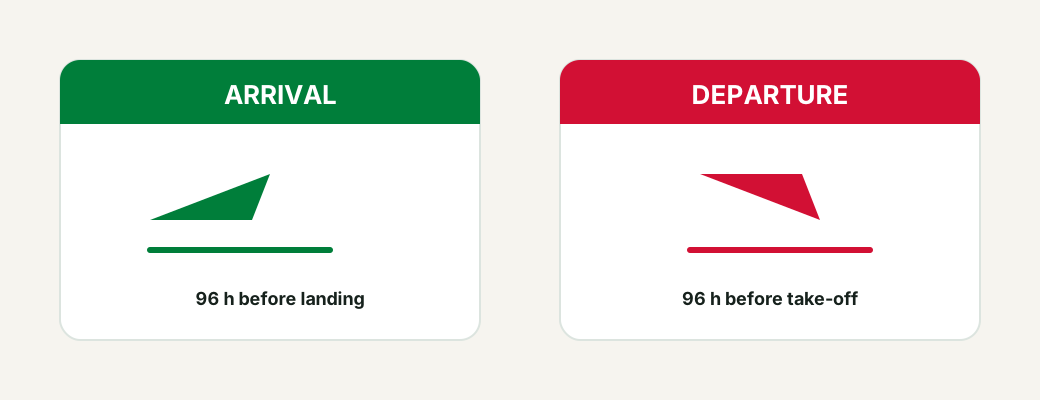
The single most important rule of the Traveller Declaration is the timing. The form opens 96 hours — four days — before your flight, and it must be submitted before you travel.
| Departure time from home | Earliest you can file | Practical advice |
|---|---|---|
| Monday 10:00 | Thursday 10:00 | File Friday or Saturday |
| Friday 23:55 | Monday 23:55 | File Tuesday morning |
| Sunday 06:00 | Wednesday 06:00 | File Wednesday, not at the airport |
Two mistakes dominate: filing too early, when the portal refuses dates outside the window and travellers assume the site is broken, and filing too late at the check-in desk on airport wifi.
The window applies independently to each leg. Your departure declaration opens 96 hours before your flight out of the Maldives, which on a one-week holiday means filing it from your resort.
Expert tip: Set two phone reminders the day you book — one for 72 hours before departure from home, one for 72 hours before your return flight. Filing at the 72-hour mark leaves you three full days to fix any problem while the window is still open.
Our guide on the 96-hour rule works through time zones, long layovers and overnight connections.
Quick summary: File each declaration inside the 96 hours before that specific flight — not earlier, and never at the airport.
What information the form asks for
Nothing on the form is obscure, but it is much faster if you gather the documents first.
- Personal details — full name exactly as printed in the passport, date of birth, sex, nationality, country of residence.
- Passport data — number, issuing country, issue and expiry dates. Your passport should have at least six months of validity.
- Flight details — airline, flight number, date, airport, and the city you fly from or to.
- Accommodation — the name of your resort, hotel, guesthouse or safari boat, plus the island or atoll.
- Contact details — a working email address, because the QR code is delivered there, and a mobile number.
- Health declaration — a short set of yes/no questions about symptoms and recent travel.
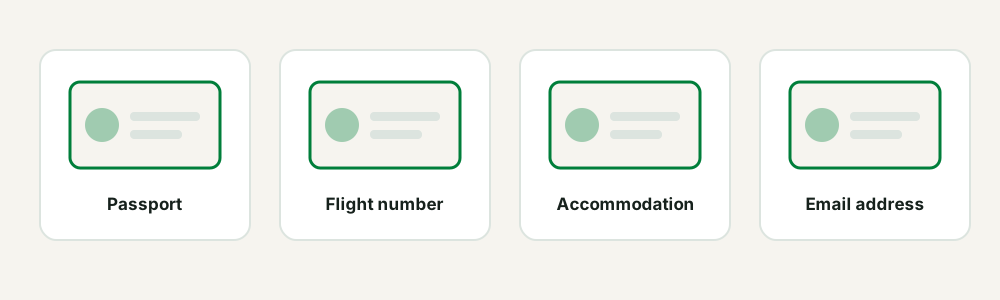
Gather all of it before you open the portal, especially for multi-island itineraries where the first property is the one that goes on the form.
Quick summary: Passport, flight numbers, accommodation name and a working email address cover almost the entire form.
Arrival versus departure: two separate declarations
A single trip to the Maldives needs two declarations, and they are not interchangeable.
The arrival declaration covers your inbound flight and asks where you will stay and for how long. It is the one nearly everybody remembers.
The departure declaration covers your outbound flight. It is shorter, confirms where you stayed and where you are flying to, and is the one travellers forget — often because they are on a resort island with patchy connectivity. Airline staff at MLE check for it at the counter.
Expert tip: If your resort has decent wifi, file the departure declaration on your first evening in the Maldives only if your return flight is within four days. Otherwise file it as soon as the window opens mid-stay, from the lobby rather than your villa.
A domestic hop between atolls does not need its own declaration, but leaving the Maldives and coming back does — the arrival and departure guide covers those combinations.
Quick summary: Two declarations per trip — one inbound, one outbound — and the departure one is the one most travellers forget.
The QR code you receive
When you press submit, the portal confirms on screen and sends a QR code to your email address, usually within a few minutes. That QR code is your proof of submission.
You show it twice: at airline check-in in your departure city, and at immigration in the Maldives, where the officer scans it. The QR is tied to one traveller and one flight, so each family member has their own and you cannot reuse an arrival QR for departure. Codes that never arrive or will not scan are covered in the QR code guide.
Quick summary: Submission returns a personal QR code by email; show it at check-in and at immigration, and keep an offline copy.
Is it no-cost?
On the official IMUGA portal the Traveller Declaration is at no cost — no government fee, no processing fee, no express option. A website that presents itself as the government and charges for the form itself is a red flag.
What legitimately costs money is assistance. Independent services — ours included — charge for reviewing your data, filing on your behalf and providing support if a QR code goes missing. That is optional. We are an independent assistance agency, not affiliated with Maldives Immigration.
Our guide to what costs nothing and what does not lays out the difference clearly.
Quick summary: The form has no cost on IMUGA; only optional review and support services carry a fee.
Why the declaration is not a visa
This confusion is common enough to deserve its own section. The Traveller Declaration and the Maldives visa are two different things.
Most nationalities receive a no-cost 30-day visa on arrival, issued by the immigration officer at the airport. You do not apply for it in advance. The officer grants it when you present:
- A passport valid for at least six months on the date of entry.
- A confirmed accommodation booking — resort, hotel, guesthouse or registered safari boat.
- An onward or return ticket out of the Maldives.
- Sufficient funds for your stay, or a prepaid booking that evidences them.
A valid QR code does not guarantee entry, and a visa on arrival does not excuse a missing declaration. You need both.
Quick summary: The TD is an immigration form; the 30-day visa on arrival is granted separately at the border. You need both, and neither replaces the other.
What happens if you do not submit it
The consequences are practical rather than dramatic, and they escalate the later you leave it.
- At check-in in your home country. Ground staff routinely ask for the QR code; without it you may be told to complete the form before a boarding pass is issued. On a slow connection at the desk, that is a real risk of missing the flight.
- On arrival in the Maldives. Expect to be pulled aside to complete the declaration while the rest of your flight walks through.
- On departure from the Maldives. Same story at the MLE check-in counter.
- Incorrect data. A mistyped passport number or a wrong flight number can be as disruptive as no declaration at all, because the record will not match your documents.
All of it is avoidable with five minutes at home. We cover the consequences in detail in what happens if you skip the declaration, including how airlines handle it at the gate.
Quick summary: Skipping the declaration risks a boarding refusal at check-in and delays at the border; wrong data causes the same problems as no data.
Key Takeaways
- The Maldives Traveller Declaration is a mandatory immigration form submitted on the official IMUGA portal for every traveller of every nationality and age.
- You need two declarations per trip: one for arrival and one for departure, each filed within 96 hours of that specific flight.
- The form covers personal data, passport details, flight information, accommodation and a short health declaration — around five to ten minutes of work.
- Submission returns a QR code by email, shown at airline check-in and at Maldives immigration; keep an offline copy.
- The declaration is no-cost on IMUGA; only optional assistance services charge a fee.
- It is not a visa — most nationalities still receive a no-cost 30-day visa on arrival with a valid passport, confirmed accommodation, a return ticket and sufficient funds.
Frequently Asked Questions about the Maldives Traveller Declaration
Is the Maldives Traveller Declaration mandatory for tourists?
Yes. It is mandatory for all travellers entering and leaving the Maldives, with no exemption by nationality or ticket type. Tourists, residents, Maldivian citizens and work permit holders all submit the same declaration.
How long before my flight can I submit it?
The window opens exactly 96 hours — four days — before the flight and closes when you travel. Filing earlier than that is not possible; the portal rejects dates outside the window.
Do I need one declaration or two?
Two per trip. One arrival declaration for your inbound flight and one departure declaration for your outbound flight. Each has its own separate 96-hour window.
Do children and babies need their own declaration?
Yes. Every traveller needs an individual declaration, including infants travelling on a parent's lap. A parent completes it on their behalf, and families can submit them together in one group session.
Is the Traveller Declaration a Maldives visa?
No. It is an immigration form. Most nationalities receive a no-cost 30-day visa on arrival, granted by the officer at the airport on presentation of a valid passport, confirmed accommodation, a return ticket and sufficient funds.
How much does the Maldives Traveller Declaration cost?
Nothing on the official IMUGA portal. Independent assistance services, including ours, charge only for optional review, filing support and customer service — never for the government form itself.
What do I do with the QR code I receive?
Save it offline and show it twice: at airline check-in in your departure city and at the immigration counter in the Maldives. Each traveller has their own code for each direction of travel.
What if I do not know my hotel yet?
You need a confirmed accommodation booking to complete the declaration properly, and immigration may ask for it on arrival. Book before you file rather than guessing a resort name.
Can I change my declaration after submitting it?
If your flight or accommodation changes, the usual solution is to submit a corrected declaration for the affected leg while the 96-hour window is still open. Keep the most recent QR code.
What happens if I arrive without a declaration?
You will typically be asked to complete it before immigration processes you, which means a delay and a queue. The bigger risk is earlier: your airline may refuse to issue a boarding pass without it.
Last updated: July 2026. Immigration rules can change; always check the current requirements on the official Maldives Immigration portal before you travel.