
Arrival and Departure Declaration: Two Forms
A practical breakdown of why Maldives requires two IMUGA declarations per trip, how the arrival and departure forms differ, and how to schedule both without stress.
Almost every traveller who books the Maldives assumes the paperwork is a single form. It is not. The Maldives Traveller Declaration is filed twice per trip: once as an arrival declaration before you fly in, and once as a departure declaration before you fly home. Both are submitted on the official IMUGA portal, both have no cost, and both share the same 96-hour window — but they are separate submissions with separate QR codes.
In 30 seconds: You need two Traveller Declarations for one holiday. The arrival form is submitted within 96 hours before your inbound flight to the Maldives. The departure form is submitted within 96 hours before your outbound flight home. Each one generates its own QR code by email. Filing only the arrival form is the single most common error travellers make, and it is usually discovered at the airline check-in desk on the way home.
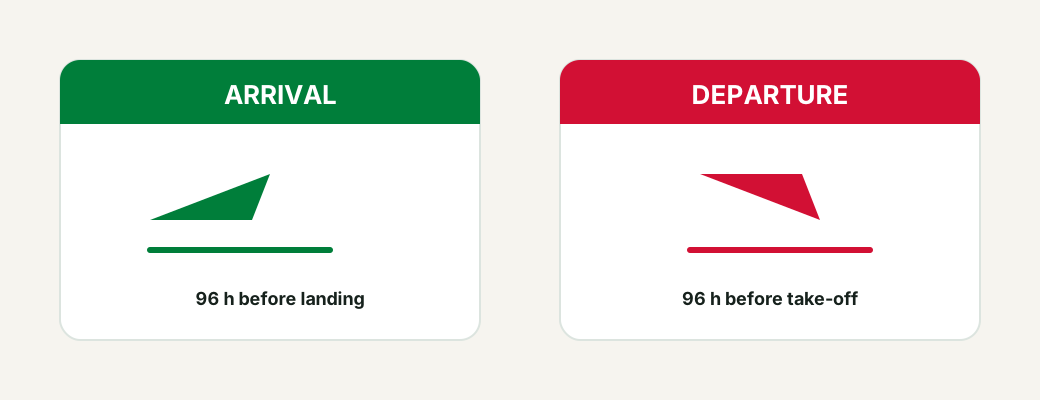
Why the Maldives asks for two declarations
The Traveller Declaration is not a visa and it is not a one-off registration tied to your passport. It is a movement record. Maldives Immigration uses it to know who is crossing the border, in which direction, on which flight, and where they are staying. A single form could not do that job, because the information that matters on the way in is not the information that matters on the way out.
When you arrive, the authorities care about where you will sleep, how long you intend to stay and whether you hold an onward ticket. When you leave, they care about which flight is taking you out of the country and whether your stay matched what you declared. Two directions, two data sets, two submissions.
There is a second, more practical reason. Plans change constantly in the Maldives. Guests extend by a night, switch islands, miss a seaplane connection or move to a different resort mid-trip. If a single declaration covered the whole journey, it would be outdated before the holiday was over. By splitting the process, the departure form always reflects reality at the moment you actually leave.
Quick summary: The declaration records a border crossing, not a person, so each direction of travel needs its own submission.
What the arrival declaration covers
The arrival Traveller Declaration is the heavier of the two. It is the form immigration officers work from when they stamp you in at Velana International Airport, and it is the one your airline may check before boarding at your origin airport.
It asks for:
- Full personal details exactly as printed in your passport, including passport number, nationality, date and place of issue and expiry date.
- Your inbound flight number, the airline and the arrival date into the Maldives.
- The country you are travelling from, plus any country you transited through on the way.
- Your accommodation in the Maldives: resort, city hotel, guesthouse or safari boat, with the island name.
- Length of stay and the address for the first night.
- A short health section covering recent symptoms or relevant travel history.
Because the accommodation field is mandatory, you cannot realistically file the arrival form before you have a confirmed booking. That is by design: the confirmed booking is also one of the conditions for the no-cost 30-day visa on arrival that most nationalities receive.
Quick summary: The arrival form is about who you are, how you are getting in and where you will stay.
What the departure declaration covers
The departure Traveller Declaration is lighter and faster. Most travellers finish it in three or four minutes because the personal and passport data is identical to what they already submitted on the way in.
What changes:
- The direction of travel switches from arrival to departure.
- You enter your outbound flight number and date, not the inbound one.
- You state your destination country — the next country you are entering, which for connecting passengers is normally the country of your final destination rather than the transit airport.
- The accommodation section either disappears or is reduced, since you are leaving.
- The health section is repeated, reflecting your condition at the time of departure.
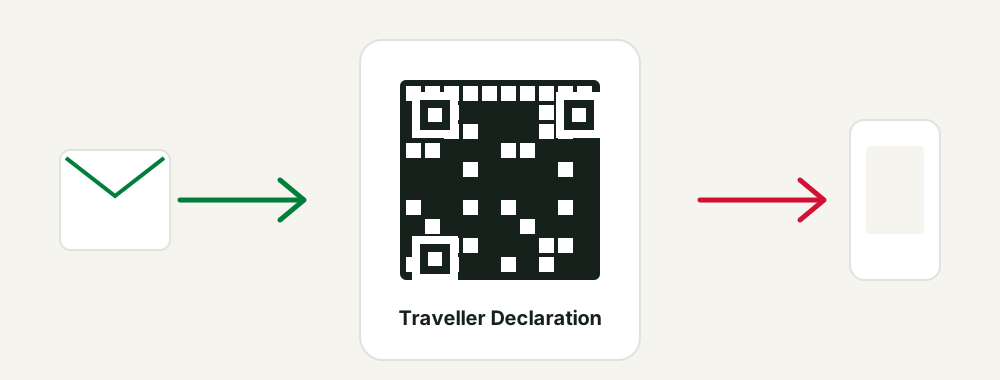
The output is the same: a QR code delivered by email, tied to that specific movement. You will be asked for it at the check-in desk of your departing airline and again at the immigration counter before security.
Expert tip: Do not assume the departure QR code is the same image as the arrival one. They look similar but encode different records. Save both in your phone gallery with obvious filenames such as "MLE-IN" and "MLE-OUT" so you never present the wrong one under pressure at the desk.
Quick summary: The departure form repeats your identity data but replaces flight, direction and destination details.
Arrival vs departure: side-by-side comparison
| Aspect | Arrival declaration | Departure declaration |
|---|---|---|
| When to submit | Within 96 hours before the inbound flight | Within 96 hours before the outbound flight |
| Where it is checked | Airline check-in at origin, immigration at Velana or other entry airport | Airline check-in in the Maldives, immigration before security |
| Flight data required | Inbound flight number and arrival date | Outbound flight number and departure date |
| Accommodation section | Mandatory and detailed | Not required or minimal |
| Country field | Country you are travelling from | Country you are travelling to |
| Health section | Yes | Yes |
| Output | Unique arrival QR code by email | Unique departure QR code by email |
| Typical completion time | 8–12 minutes | 3–5 minutes |
| Cost on IMUGA | No-cost | No-cost |
| Applies to children and infants | Yes, one per traveller | Yes, one per traveller |
The row that catches people out most often is the timing row. Both windows are 96 hours, but they open on different days, and for a one-week holiday they never overlap.
Quick summary: Same portal, same 96-hour rule, different direction, different flight data and different QR code.
The 96-hour rule applied twice
The 96-hour window is the mechanical heart of the whole process. IMUGA will not accept a declaration submitted earlier than four days before the flight it refers to. There is no early-bird option and no way to lock it in months ahead when you are organised and have time.
Applied twice, the rule looks like this:
- Count back 96 hours from the scheduled departure time of your inbound flight. That is the moment the arrival form becomes available.
- Submit the arrival declaration at any point between that moment and boarding. Most travellers do it two or three days out.
- Count back 96 hours from the scheduled departure time of your outbound flight. That is the moment the departure form becomes available.
- Submit the departure declaration in that window, ideally 48 hours before, while you still have decent connectivity.
- Check that two separate confirmation emails, each with its own QR code, have arrived.
If your holiday is shorter than four days, the two windows overlap and you can technically file both before you even leave home. On a seven- or ten-day trip they do not overlap at all, which is exactly why so many people forget the second one.
For the full mechanics of the timing rule, including time zones and how the countdown behaves with delayed flights, see our guide to the 96-hour submission window.
Quick summary: Two independent 96-hour countdowns, one per flight, that rarely overlap on a normal holiday.
The classic mistake: thinking one form covers the trip
If you spend ten minutes reading traveller forums, you will find the same story repeatedly. Someone files a declaration before flying to Malé, has a flawless holiday, arrives at check-in for the flight home, and is asked for a departure QR code they have never heard of.
Why it happens:
- The arrival process is highly visible. Airlines remind you, resorts remind you, travel agents remind you. The departure process is not.
- The confirmation email from the arrival submission looks final. Nothing in it shouts "you must do this again".
- Resort connectivity is patchy. Guests postpone the second form and then forget.
- Travellers conflate the declaration with the visa. The visa on arrival is a single event, so people assume the paperwork is too.
The consequence is rarely catastrophic — you can usually complete the departure form on your phone at the airport — but it is stressful, it happens in a queue, and it depends entirely on the airport network holding up. In peak season at Velana, that is not a comfortable bet.
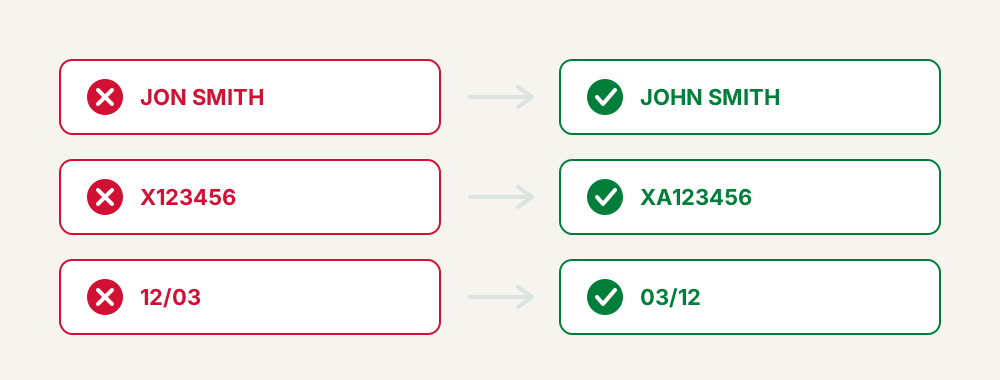
For a wider list of pitfalls, from passport typos to wrong flight numbers, read our guide on common Traveller Declaration mistakes.
Quick summary: The departure form is forgotten because nothing in the arrival process reminds you it exists.
How to organise both forms on a 7 to 10-day trip
A little planning removes the problem entirely. Here is a workable schedule for a standard ten-night holiday.
Before you leave home
- Day minus 4 to minus 2: the arrival window opens. File the arrival declaration with your inbound flight and first-night accommodation.
- Save the arrival QR code as a screenshot and as an offline PDF. Do not rely on your inbox.
- At the same time, put a calendar alert on your phone for the day the departure window opens. Title it something unmissable.
During the trip
- Day 6 or 7 of a ten-night stay: the departure window opens. Do it that evening, at the resort, with a drink in hand.
- Use the resort Wi-Fi rather than a weak mobile signal.
- Screenshot the second QR code immediately.
Before heading to the airport
- Confirm both QR codes are on your phone and, ideally, printed.
- Re-check the outbound flight number against your ticket. Schedule changes are common.
The calendar alert is the single highest-value step in that list. It costs fifteen seconds and eliminates the most common failure mode in the entire process.
Expert tip: Set the departure reminder for the evening you check in to your resort, not for a specific date. Resort evenings are unstructured and you have connectivity. Airport mornings are neither.
Quick summary: File arrival before leaving home, set a phone alert, and complete the departure form mid-holiday from the resort.
Departures from Velana and the other airports
Velana International Airport (MLE) in Malé handles the overwhelming majority of international departures, and it is where most travellers will present the departure QR code. But the Maldives has other international gateways, and the process is identical at each.
- Velana (MLE), Malé — main hub, busiest desks, longest queues in peak season. Allow extra time.
- Gan International Airport (GAN), Addu Atoll — serves the far south, useful for guests staying in Addu or Fuvahmulah.
- Maafaru International Airport (NMF), Noonu Atoll — mainly private and regional traffic serving northern resorts.
- Hanimaadhoo International Airport (HAQ), Haa Dhaalu Atoll — northern gateway with growing international service.
Your declaration does not need to name the airport in a special way beyond your flight details, but do make sure the flight number you enter is the international leg, not a domestic hop. If you fly Malé to Gan domestically and then leave the country from Gan, the departure declaration should reference the international flight out of Gan.
Quick summary: All four international airports use the same declarations; enter the international flight number, never the domestic connection.
Seaplanes, speedboats and how transfers affect your timing
Getting to your resort is rarely a simple taxi ride. Transfers reshape your schedule and, indirectly, your declaration planning.
Seaplane transfers operate only in daylight hours. If your international flight lands late in the afternoon, you may spend a night in Malé or Hulhumalé before flying on the next morning. That matters for the arrival form, because the accommodation you declare for the first night should be the Malé hotel, not the resort you reach on day two.
Speedboat transfers run more flexibly, including at night for many nearby resorts, but they are weather-dependent. Rough seas can shift schedules by hours.
Domestic flights plus speedboat is the standard combination for distant atolls, adding two or three hours of travel and a domestic check-in in the middle.
On the way out, resorts require you to leave far earlier than you would for a normal airport run. A seaplane back to Malé is usually scheduled three to four hours before your international departure, and some resorts insist on the day before for early morning flights. That means your practical deadline for the departure declaration is not the flight time — it is the moment you leave the island and lose reliable Wi-Fi.
Build your plan around that earlier deadline and the paperwork never becomes a problem.
Quick summary: Your real departure-form deadline is when you leave the resort, not when your plane takes off.
Group and family trips: two forms per person
Every traveller needs their own declaration in each direction. A family of four on a one-week holiday therefore submits eight declarations in total: four arrival and four departure.
The portal makes this manageable. From a single account you can create a group and add each traveller, so the shared data — flight, accommodation, dates — is entered once rather than four times. Each person still generates an individual QR code.
Points worth knowing:
- Infants and children need their own declarations, with their own passport details. There is no family exemption.
- The person who submits the group does not become a representative for immigration purposes; each traveller is assessed individually.
- If one member of the group changes their return flight, only that person's departure form needs to be redone.
Families travelling with young children should read our dedicated guide on declarations for families and children.
Quick summary: Multiply by two directions and by every traveller, including babies, then use the group feature to save time.
What to do if the departure declaration goes wrong
Things do go wrong: a flight is rescheduled, a name is mistyped, an email never arrives. None of it is fatal if you act early.
- Wrong flight number. Submit a fresh departure declaration with the correct details. Present the newest QR code at check-in.
- Email not received. Check spam and promotions folders first. Verify the address you typed. If it is genuinely missing, resubmit.
- Flight moved to a different day. If the new date is still within the window you filed for, the record generally holds; if it has shifted substantially, file again.
- Passport number typo. Do not attempt to talk your way through it. A mismatch between the declaration and the passport is the kind of discrepancy immigration officers notice. Resubmit correctly.
- No connectivity at the resort. Ask reception. Most properties will let you use an office connection for something like this.
You can also verify the state of a submission at any time on our status page.
Quick summary: Almost every departure-form problem is solved by resubmitting a corrected declaration, so leave time to do it.
If you are new to the whole process, start with our overview of what the Maldives Traveller Declaration is, then work through the step-by-step IMUGA walkthrough.
Key Takeaways
- The Maldives requires two Traveller Declarations per trip: one for arrival and one for departure.
- Each has its own 96-hour window, counted from its own flight, and on a normal holiday the two windows do not overlap.
- The arrival form is longer and includes accommodation; the departure form is short and focuses on the outbound flight and destination country.
- Each submission produces a separate QR code by email, needed at airline check-in and immigration.
- Your practical deadline for the departure form is the moment you leave the resort, not the flight time.
- Every traveller, including infants, needs both forms, so a family of four files eight declarations.
Frequently Asked Questions about arrival and departure declarations
Do I really need two separate declarations for one holiday?
Yes. Maldives Immigration treats each border crossing as its own record. One declaration covers your entry, a second covers your exit, and each generates a distinct QR code.
Can I submit both declarations at the same time before I travel?
Only if your entire trip is shorter than 96 hours. Otherwise the departure window has not opened yet when you file the arrival form, and IMUGA will not accept it.
When exactly does the departure window open?
Exactly 96 hours — four days — before the scheduled departure time of your outbound international flight. Most travellers file it two days before.
What happens if I forget the departure declaration?
You will normally be asked for it at the airline check-in desk and told to complete it on the spot. It is doable on a phone but stressful, and it depends on the airport network working.
Is the departure declaration also no-cost?
Yes. Both forms are at no cost on the official IMUGA portal. Paid services are optional assistance, never a fee for the declaration itself.
Does the departure form ask for my accommodation again?
No, or only minimally. You are leaving the country, so the relevant details are your outbound flight and the country you are travelling to.
Which flight number do I enter if I have a connection?
Enter the international flight leaving the Maldives. Your onward connection in Doha, Dubai or Istanbul is not the flight the Maldivian authorities are recording.
I am flying out of Gan instead of Malé — is the process different?
No. Gan, Maafaru and Hanimaadhoo use the same declaration as Velana. Just make sure the flight number you enter is the international departure, not a domestic hop.
Do children need their own departure declaration?
Yes. Every traveller, including infants, needs an arrival declaration and a departure declaration in their own name with their own passport details.
My return flight changed after I filed the departure form. What now?
Submit a new departure declaration with the correct flight details and present the newest QR code. There is no penalty for resubmitting.
Last updated: July 2026. Immigration rules can change; always check the current requirements on the official Maldives Immigration portal before you travel.